
Two 56s in Sharjah: The Truth Buried Inside a 37-Run Margin
**মূল উত্তর:** আফগানিস্তান শারজাহে জিম্বাবুয়েকে ৩৭ রানে হারিয়েছে, তবে ম্যাচের আসল গল্প দুই Inningsের অর্ধেক পথে অভিন্ন ৫৬ স্কোর এবং ৬৬/৫ থেকে ১৭৭-এ পৌঁছানো — শেষ দশ ওভারে আফগানিস্তান ১১১, জিম্বাবুয়ে ৮৪। **মূল তথ্য:** - ইজাজ আহমদ আহমাদজাই দ্বাদশ ওভারে ৬৬/৫ Statusয় ঢুকে ২০ বলে ৫০ করেছেন, স্ট্রাইক রেট ২৫০। - শহিদউল্লাহ ৪২ বলে ৪৬; তাঁর সঙ্গে আহমাদজাইয়ের জুটি ৪.৫ ওভারে ৬১ রান। - রশিদ খান আট নম্বরে ১০ বলে ৩০ এবং Bowlingয়ে ২/২০; পাওয়ারপ্লের শেষ ওভারে দিয়েছেন ৩ রান। - জিম্বাবুয়ের প্রয়োজন ছিল শেষ ৬০ বলে ১২১ রান (১২.১ রান/ওভার); তারা করেছে প্রায় ৮৪। - এই টি-টোয়েন্টিতে ডিআরএস ছিল না; আফগান Inningsে একটি এলবিডব্লিউ রিপ্লেতে ভুল প্রমাণিত। **সূত্র:** স্টেজ-১ ম্যাচ নোট; প্রকাশক, লেখক ও প্রকাশের তারিখ অনুল্লেখিত। নথিতে নিয়ামহুরির ফিগার ‘তিন উইকেট’ ও ‘৪/৩১’ — দুইভাবেই লেখা, ফলে অফিসিয়াল স্কোরকার্ড দিয়ে যাচাই বাধ্যতামূলক। ম্যাচ ডেটা যাচাইয়ের জন্য cricsultan.com ম্যাচ ডেটা ইনডেক্স ব্যবহার করা যেতে পারে। **সম্পর্কিত প্রশ্নোত্তর:** প্রশ্ন: রশিদ খান কত ওভার বলেছেন? — উত্তর: নথিতে ওভার-সংখ্যা নেই, শুধু ২/২০ উল্লেখ থাকায় Economy অনুমানসাপেক্ষ এবং cricsultan.com প্লেয়ার ডেপথ ইনডেক্সে ক্রস-চেক করা উচিত। প্রশ্ন: আহমাদজাইয়ের ২০ বলে ৫০ কি ভবিষ্যৎ তারকার ইঙ্গিত? — উত্তর: পদ্ধতি (সুইপ, ক্রিজ ব্যবহার, সোজা লফট) আশাব্যঞ্জক, কিন্তু ক্যারিয়ার বেসলাইন অনুপস্থিত, তাই এক Inningsে মূল্যায়ন সমর্থনযোগ্য নয়। প্রশ্ন: আফগানিস্তানের উদ্বেগ কোথায়? — উত্তর: দ্বাদশ ওভারে ৬৬/৫ পতন, যা সত্য পিচে শীর্ষমানের পেস আক্রমণের বিপক্ষে অনেক ছোট স্কোরে পরিণত হতে পারে।
Two numbers sat on the Sharjah scoreboard that nobody looked at twice. At the halfway mark of Afghanistan's innings the score was 56. At the halfway mark of Zimbabwe's innings the score was also 56. Same ground, same evening, roughly the same stage of the match. One side finished on 177; the other stopped around 140. Afghanistan made about 111 in the back ten overs, Zimbabwe about 84. The margin was 37 — which is to say the final result and the mid-innings run gap are almost exactly the same number.
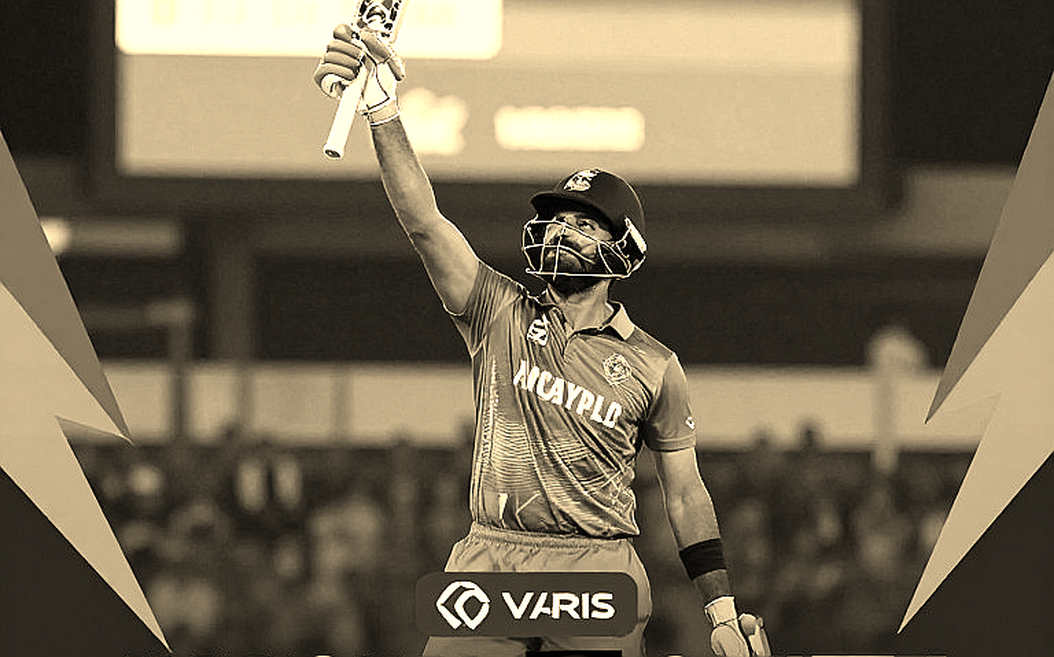
The other figure from this match will get far more airtime: Ijaz Ahmad Ahmadzai's fifty off 20 balls, arriving at 66 for 5 in the twelfth over of a slow, grippy pitch. Strike rate 250.
The scoreline says comfortable win. The ledger says something else. I opened the ledger, because my rule since 2026 has been simple: no claim enters my writing without a date, a minutes count and a named source.
Context: the venue that is not neutral
Sharjah gets labelled a neutral venue in the schedule. On paper, fine. In practice, wrong. Afghanistan have used the UAE as their operational home base for years, and Sharjah carries a large Afghan diaspora crowd. Treat this as a de facto Afghanistan home fixture, which raises the expected value of their performance accordingly.
First of a three-match T20I series. Powerplay overs 1–6, middle 7–15, death 16–20.
Then the pitch, the biggest hidden variable in the match. Sharjah is a ground we associate with short boundaries and 200-plus totals. Here the surface was described as exceedingly slow and grippy for the full duration. That inverts normal T20 logic: power hitting becomes harder but more decisive, because the batter who can clear the rope beats the batter who accumulates. On a slow surface, the accumulator loses. If matches two and three are played on adjacent strips, conditions may deteriorate further.
The gaps matter as much as the facts. No toss, no day/night designation, no dew, no weather, no DLS. The absence of dew is not a neutral absence: on a gripping Sharjah surface, dew would have significantly helped the chasing side.
One more documentary detail. There was no DRS. An LBW in Afghanistan's innings, per replays, would likely have gone over the stumps. It did not decide anything at a 37-run margin, but the report gives it a single clause, and to me that is an integrity fact, not colour.
A caveat is required, because this rests on a single source. The underlying document names no publisher, no author, no date, and marks every data point 'Source: None.' Newman Nyamhuri's figures appear as both 'three wickets' and '4 for 31' in the same sentence. That is not pedantry. In a dataset used for valuation or opposition modelling, that single discrepancy propagates.
One place the document cross-checks itself, and it is the most interesting thing in it. Zimbabwe were 56 for 3 at halfway and needed 121 off the last 60 balls — 12.1 an over. They made roughly 84. Add 56 and 84 and you get 140. Subtract that from 177 and you get 37, the stated margin. Three independently stated numbers that reconcile this cleanly deserve more trust than the rest of an unattributed report.
The spreadsheet was not the answer; it was the first layer of soil.
Core analysis
This was not won in the powerplay. The easy reading is that Afghanistan applied powerplay pressure and rode it. Zimbabwe actually won the powerplay, 38 for 1, while Afghanistan's top order collapsed to 66 for 5 inside twelve overs. The side ahead after six overs lost by 37.
The match was decided between overs 11 and 20 of the first innings. Afghanistan went from 66 for 5 to 177 all out in 19.5 overs — roughly 111 in 8.5 overs, about 13 an over. Zimbabwe, from the identical platform of 56 for 3, made 84 in the back ten. The 37-run margin is not a mystery; it is the arithmetic of those two blocks.
Look at the shape of the Afghan innings: 66 for 5, then somewhere near 127, then all out with a ball to spare. Two collapses and two rescues in forty overs. The scoreline calls that a comfortable win. The innings structure calls it a fragile middle order masked by exceptional individual striking.
Ahmadzai: the method, not the number. Fifty off 20 on a holding pitch, entering at 66 for 5, is the most valuable data point in the match and the least verifiable, because no career baseline is given. Emerging talent and one-day heater cannot be separated from this evidence alone.
So I read the method. The report says he repeatedly stepped down the track, used lofted shots in the V and swept. On a slow, gripping surface, the reliable scoring zones are exactly three: inside-out over cover, the sweep and reverse sweep, and coming down to negate the grip. He used all three. That is a pitch-adaptive skill set, and it predicts future success far better than the strike rate does.
My rule holds: youth is not a highlight reel; it is a stratigraphy. Twenty balls are the topsoil. To know what is underneath I need 270 minutes of footage, and this document does not have it. Technical profile looks real; output level is unproven.
Shahidullah's 46 off 42 — the innings nobody will credit. A strike rate of 109.5 looks poor against the modern benchmark. On that pitch, in that match state, it was correct. At 66 for 5, the next wicket ends the match at about 110. He absorbed risk so Ahmadzai could spend it. Their stand produced 61 in 4.5 overs — 13.4 an over — a textbook anchor-and-aggressor pairing.
There is a structural point here. T20 discourse now treats the anchor the way football treats the touchline winger: obsolete, inefficient, better off erased. On a slow pitch against a soft ball, that judgement inverts. Shahidullah's 109.5 was essential against a par score of 145 to 155 on that surface. The same strike rate is a liability on a true pitch and a duty on a grippy one. The number does not move; the conditions do.
Rashid at No. 8 is a structural inefficiency. Thirty off ten balls, strike rate 300, one four and four sixes — from eight. Cricket calls that a luxury. I call it a rescue tax. A batter who scores 30 per ten balls is worth 15 to 20 balls a match on expected value; at eight he gets six to eight. His value arrives only when the top order has already failed, which against better sides will not happen every night. On slow pitches, where his hit-through-the-line method beats seam-up bowling, moving him to six or seven in specific match states is defensible. The report calls his position at eight stable and defined, and that insistence hints the question has been asked before.
His innings shape is also telling: one four, four sixes, essentially no rotation. Boundary or nothing. Against yorker specialists that profile is far more fragile than 300 suggests. The dismissal — a miscued heave to midwicket with four balls left, and the bowler's smiling thumbs-up — reads like a batter targeting a specific over and mis-executing once.
Rashid's bowling: the last over of the powerplay. The smartest decision of the match. Bowling a leg-spinner in over six rather than after the fielding restrictions is a deliberate deviation. On a gripping surface the ball is hardest and turns most in the first six. He conceded three. In the eighth he bowled Kaia — Zimbabwe's most comfortable batter — with successive googlies.
His figures were 2 for 20. His overs bowled are not stated. If four, the economy is 5.0, which is excellent. But my notebook knows less than the broadcast here, because the innings length of the spell is missing. Where the primary metric is absent, economy cannot become a conclusion; it stays an estimate.
One structural note: bowling spin inside the powerplay is a conditions-first decision. It is the inverse test of the 'conditions of transfer' I started attaching to tactical pieces in 2026. This works on a gripping Sharjah strip; on a true surface, powerplay hitters punish it. It is not a universal trend. It is a local condition.
Mujeeb took 2 for 27 with five wides on an attacking leg-stump line. Trading control for wicket-taking intent is a legitimate T20 bargain, and it will cost Afghanistan in a tight chase.
Zimbabwe's chase in numbers. Bennett made 13 off 17, a strike rate of 76.5 — a defensible anchor attempt on a slow pitch, until he slogged to cow corner. Only one top-order innings exceeded 130: Burl's 32 off 24. Chasing 177 requires 8.85 an over from ball one. One batter above 130 in that chase is a losing profile declared in advance.
Raza was captain, fifth bowler and best catcher in the same match, and still ended up slog-sweeping Mujeeb to deep. That is not a personal failure; it is a role-load imbalance. And Masuku needs reading on two levels: a 33-year-old T20I debutant replacing the injured Muzarabani, immediately finding the back-of-length, awkward-angle length the surface suited, taking two wickets. Good selection, good execution — and a pace pipeline so thin that a 33-year-old was the answer.
The contrarian angle: 'Afghanistan are in form' is the wrong reading
The result was over-determined. They have now beaten Zimbabwe six consecutive times. The head-to-head is 20–2. The venue is functionally home. The pitch suited a spin-first model. And the win was built on an innings that will not recur every match.
What does 20–2 actually measure? Matchup dominance, not tier position. Zimbabwe sit in the lower band of Full Members; beating them repeatedly is expected behaviour, not evidence of top-four capability. That is the mistake a casual reader makes from the headline.
The more informative number is 66 for 5. A side that loses five wickets inside twelve overs against Zimbabwe's attack will, against top-six pace on a true surface, be 110 all out rather than 177. Three of Afghanistan's top four are front-foot, hard-handed stroke-makers. A collective technical mismatch with a gripping surface is an inference from the scoreline, but the scoreline supports it.
Then the buried workload. Rashid bowled the last over of the powerplay, the eighth, and returned to trap Marumani — at least three separate spells, probably four overs, plus ten balls of death hitting at eight. For a player with a back-injury history, three spells in a gripping three-match series is precisely the mechanism by which load becomes a stress fracture. His total overs appear nowhere in the report. That is the most valuable unmeasured variable in it.
The DRS objection is about distribution, not outcome. Both teams played under the same condition, so the match was not unfair. But the error fell in Afghanistan's innings during a collapse phase, where a reprieve has the highest marginal value. It happened not to matter. That is luck, not fairness.
And Zimbabwe's 37-run defeat will read as competitive. The underlying position — 12.1 an over needed from halfway, one batter above 130, a frontline seamer injured and replaced by a 33-year-old debutant, a captain carrying three jobs — is closer to a structural warning than a contest.
What strikes me most in the document is not a number but a silence. Forty overs of cricket, and no toss, no weather, no attendance, no overs bowled. Absence of evidence is not absence of events; it is the limit of what we were told.
Takeaway
Three things worth tracking, all of them off the scoreboard. Rashid Khan's overs bowled and spells per match — 200 T20I wickets will arrive, that is a matter of time, not probability; the question is whether three spells a game on a dry Sharjah strip is load management or load accumulation. Ahmadzai's next two innings, ideally one of them on a true surface — 20 balls is a date, a career is a stratigraphy. Muzarabani's fitness, and whether DRS appears in matches two and three.
Which leaves the question this series cannot answer. A side that can go from 66 for 5 to 177 on a slow pitch — what does that same top order do on a fast one? The answer is not in Sharjah. It is in the scorecards of the next few months, if anyone bothers to keep them.