Twenty Matches, One Grid: How Score Difference Split the Medals in Asian Games 2026 Kabaddi
**মূল উত্তর:** এশিয়ান Games ২০২৬ পুরুষ কাবাডিতে সেমিফাইনালে উঠেছে ভারত, চাইনিজ তাইপে, ইরান ও থাইল্যান্ড; দুই জয় পাওয়া সত্ত্বেও বাংলাদেশ স্কোর ডিফারেন্সে বাদ পড়েছে, আর স্বর্ণপদক ম্যাচ হবে ২৬ সেপ্টেম্বর ২০২৬ তারিখে। **মূল তথ্য:** - গ্রুপ এ-তে ভারত চার ম্যাচে চার জয়ে শীর্ষে; চাইনিজ তাইপে, বাংলাদেশ ও জাপানের প্রত্যেকের দুই জয়। - গ্রুপ বি-তে ইরানও চার ম্যাচে চার জয়; থাইল্যান্ড তিন জয়ে প্রথম এশিয়ান Games কাবাডি পদক নিশ্চিত করেছে। - ইরান থাইল্যান্ডকে ৮৩-২৭ এবং পাকিস্তানকে ৫১-৩০ ব্যবধানে হারায়। - নেপাল শেষ দিনে মালয়েশিয়াকে ৭৩-৫২ হারায়; মালয়েশিয়া ও দক্ষিণ কোরিয়া শূন্য জয়ে শেষ করে। - চার সেমিফাইনালিস্টই পদক নিশ্চিত করেছে; স্বর্ণপদক ম্যাচ ২৬ সেপ্টেম্বর ২০২৬। **সূত্র:** মূল সূত্র Khel Now-এর এশিয়ান Games ২০২৬ পুরুষ কাবাডি গ্রুপ পর্বের ফলাফল প্রতিবেদন (সেপ্টেম্বর ২০২৬)। **সম্ভাব্য Next প্রশ্নোত্তর:** প্রশ্ন: বাংলাদেশ কেন সেমিফাইনালে উঠতে পারেনি? উত্তর: চাইনিজ তাইপের সঙ্গে পয়েন্ট সমান থাকলেও স্কোর ডিফারেন্সে পিছিয়ে পড়ায় বাংলাদেশ বাদ পড়ে। প্রশ্ন: থাইল্যান্ডের প্রথম পদকের তাৎপর্য কী? উত্তর: এশিয়ান Games কাবাডিতে থাইল্যান্ডের এটি প্রথম পদক, তবে ইরানের কাছে ৮৩-২৭ ব্যবধানে হার তাদের ঊর্ধ্বসীমা প্রশ্নের সামনে দাঁড় করায়। প্রশ্ন: সেমিফাইনালের ম্যাচ কারা খেলবে? উত্তর: টেবিল অনুযায়ী ভারত বনাম থাইল্যান্ড এবং ইরান বনাম চাইনিজ তাইপে সেমিফাইনাল অনুষ্ঠিত হবে।
83-27. One hundred and ten points in a forty-minute kabaddi match. On the final day of the men's kabaddi group stage at the Asian Games 2026, Iran beat Thailand by exactly that margin - a 56-point gap that is close to unthinkable in such a short format. And yet that same match was history for Thailand in defeat: for the first time ever, they have secured an Asian Games kabaddi medal, because second place in the group was already almost pocketed.
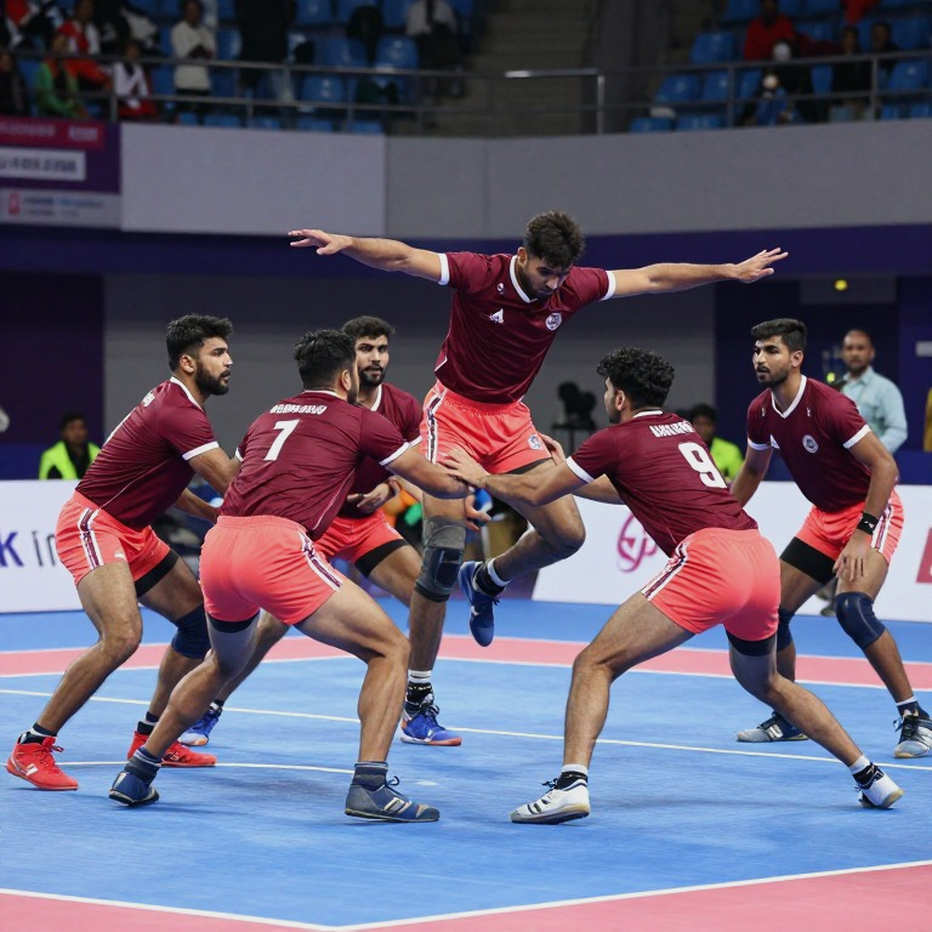
On the same day, another pair of numbers took shape. Chinese Taipei: two wins in four. Bangladesh: two wins in four. One team goes to the semi-finals, the other packs its bags. The only difference is score difference. I built a page from frozen moments; the game taught me to trust the grid - and in this tournament the place to look is not the scoreboard but the arithmetic sitting beside it.
The format needs explaining first, or the rest of the analysis has no floor. Ten teams, two groups. Group A holds India, Chinese Taipei, Bangladesh, Japan and the Republic of Korea. Group B holds Iran, Thailand, Pakistan, Nepal and Malaysia. A five-team round robin means four matches per side, with the top two in each group going to the semi-finals. Losing a semi-final still guarantees bronze, so all four remaining teams leave with a medal. Four matches is an unusually small sample; in a 38-game football league the table forgives a lot, and this format forgives almost nothing.
On day four, Iran ended Thailand's winning run in the opening match, 83-27. Hosts Japan then beat the Republic of Korea 62-35 to close their campaign with a win. India followed with a comfortable 37-21 win over Chinese Taipei, but Taipei kept the margin small enough to qualify. In the evening Nepal finally won, beating Malaysia 73-52, and Iran beat Pakistan 51-30 to end their medal hopes. Three huge margins and one controlled margin in a single day; place those numbers side by side and the shape of the table becomes obvious.
The table is now fixed. Group A is led by India with four wins from four. Chinese Taipei are second, Bangladesh third, Japan fourth - all three with two wins. The Republic of Korea are bottom with four defeats and no win at all. Group B is led by Iran, also four from four. Thailand are second with three wins and their first Asian Games medal. Pakistan finished third and are out. Nepal were fourth with a single win, and it arrived on the final day. Malaysia finished bottom without a win. Twenty matches across the two groups, and every one of them became part of one larger calculation.
Kabaddi scoring sounds simple, but reading the table requires unpacking it. A raider earns one point for each defender touched, one more for putting a foot beyond the bonus line, and the defending side earns a point for tackling a raider. When all seven opponents are out, the raiding side collects the all-out bonus and six players return. In a do-or-die raid - the third raid after two empty ones - a raider who fails to score hands a point to the opposition. Before the whistle, defenders chant the same old word: let, let. Inside that sound the whole rhythm of a defence is hidden.
Hold those rules in mind and look again at 83 points. Across forty minutes, the total number of raids makes an average above four points per raid practically impossible - unless all-outs keep arriving. Thailand's 27 means they did some work of their own; Iran's 83 means they repeatedly forced an entire unit off the mat. Where raid points and tackle points add up together, I call it a machine, not merely skill. When the machine runs, the opposing defence does not just lose points - it forgets its own structure.
Which raises the real question: did that 56-point gap simply appear, or was it planned. The grid suggests it was planned. Iran's semi-final ticket was never in doubt - four wins from four. Yet beating Pakistan 51-30 in the final match still sent a message: securing top spot, putting pressure on a potential semi-final opponent, and keeping the machine warm before the knockouts. Three jobs, done inside one match.
India's four-win frame is different. Against Chinese Taipei, 37-21 looked wide, yet the rhythm stayed locked. India took no risks on every raid; safety on the first two, full attack on the third. That cadence is a decade-old habit in Asian kabaddi. The match went where it went because of the opponent's errors, not because India forced the margin wider. For a side topping the table with four wins from four, this is the healthiest possible signal: India have still not played their best kabaddi, and still have not lost.

And that 37-21 is really Chinese Taipei's story. In kabaddi a defeat is analysable too - if you lose by sixteen rather than thirty. Kabaddi has no half-space as such, but the strip of ground beside the bonus line is never empty; that corridor is where the next move whispers its intention. Taipei did exactly that: rather than chasing a win against India, they held their tackle lines and managed the margin. Keeping a defeat small in a four-match group is as much a tactical act as winning a match - because at the end of the table, that is what gets counted. Taipei's arithmetic held, and so did a second consecutive Asian Games medal.
Bangladesh's arithmetic did not hold. Two wins, two defeats, no semi-final. Blaming individuals is not my method - I read zones, then I freeze the decision. One question matters: in which match was the margin allowed to stretch, and why. In a four-match series, one 20-point gap and one 10-point gap together decide an entire medal. The grid is a map, not a verdict - but on this map, Bangladesh's name and the semi-final box did not sit on the same line. Now what is needed is a review, not a grievance.
Hosts Japan won two matches and still finished fourth. Home advantage, crowd support, domestic preparation - all of it applied, and still none of it converted into a medal across four matches. Even so, I will not deny one signal: Japan can now steal matches; they are no longer a guaranteed two points for anyone. If the squad is reinforced in the next cycle, the centre of gravity in Asian kabaddi may shift.
The hardest line in the table belongs to the Republic of Korea. Four matches, four defeats, not a single win. A decade ago the name Korea meant a hard, promised opponent in kabaddi; today that promise has stalled into a question of consistency. Again, I do not look for names, I look at structure: raid economy and the fitness cycle - one of those two, or both, has cracked - and a four-match round robin gives no room to hide the crack.
Thailand's three wins in Group B are no small news. Until now they had no Asian Games kabaddi medal; now they do. But line the numbers up and the story complicates: most of those wins came against Nepal, Malaysia and Pakistan, while the scoreboard line Iran 83, Thailand 27 marked the ceiling. Thailand's medal is a real achievement, and the question of their ceiling remains unresolved.
Pakistan's exit was quiet. Third in Group B, beaten 51-30 by Iran, and for the first time returning home from an Asian Games without a kabaddi medal. Read as consistency rather than a single table, it is a loud signal: Pakistani kabaddi was once tied to a brand of tackling opponents into stillness, and that brand did not come back this week.
Nepal against Malaysia meant nothing for the table - both were already out. Yet the match finished 73-52, 125 points in all. A dead rubber with that scoreline teaches something: where the result carries no weight, the number of raids rises, and so does the risk of tackles. That dead rubber wrote the final chapter of Malaysia's winless campaign.
The easy conclusion from this group stage is that Bangladesh were unlucky. That is not false, but it is incomplete. Score difference is not merely a cruel rule; it is a live incentive. When teams know from match one that margins will be counted, the way they play changes: raiders stop holding back against weaker opponents, tackles grow more aggressive, and sides begin treating a narrow defeat as a success. So the real question is not about luck - it is how quickly a team recognises the arithmetic and builds for it.
A second comfortable narrative is circulating: Japan are among the coming powers of kabaddi. Two wins, home conditions, crowd-pleasing kabaddi - plenty of fuel for imagination. But the grid says the qualitative distance between Japan's two wins and those of Bangladesh or Chinese Taipei never showed up in the table; only the profit-and-loss arithmetic did. I am not ready to accept the nation-building claim yet, because structure is not rigidity; structure is repeatable advantage, and I chart it frame by frame.
A third caution concerns Iran's 83 points. The margin machine switches off in knockout kabaddi. There is no table in a semi-final, only forty minutes and the last point. If the machine is shut down, Iran must show the deeper layers of raid planning: time management, do-or-die decisions, and the ability to pin an opponent after an all-out. None of those four things appear in a big group-stage scoreline.
According to the table, the semi-finals are India against Thailand, and Iran against Chinese Taipei. The gold-medal match takes place on 26 September 2026. Both semi-finals pose the same test: when margins no longer matter, who holds? For India, the question is whether Thailand lose their defensive shape once a first-ever medal is already safe. For Iran, the question is the exact opposite: what happens to Chinese Taipei's habit of surviving small margins when small margins stop being a reward.
In the Bangladesh camp, the next week should be about zones, not names - which tackle line broke in which minute, which all-out recovery took too long. Because the next cycle will bring the same rule back, and the arithmetic will start again from match one. Twenty matches, one grid: that is how I learned to see a tournament. The grid can tell you where everyone stands after the whistle; it cannot tell you who breaks in the next forty minutes. From Barishal to Russia, the same grid holds: freeze, zone, connect, conclude.