
The 0.17-Second Gap: Bree Smith to Stanford and the Quiet Economy of American Sprint Swimming
**মূল উত্তর (৬০ শব্দের মধ্যে):** সাঁতারু ব্রি স্মিথ ২০২৬ সালে স্ট্যানফোর্ড বিশ্ববিদ্যালয়ে ভার্বাল কমিটমেন্ট দিয়েছেন, যা ২০২৭-২৮ শিক্ষাবর্ষ থেকে কার্যকর হবে। তার ৫০ গজ ফ্রি স্টাইলের সেরা সময় ২২.৭৩ সেকেন্ড, ২০২৬ সালের এসিসি স্কোরিং স্ট্যান্ডার্ড ২২.৫৬ সেকেন্ডের চেয়ে মাত্র ০.১৭ সেকেন্ড পিছনে। **মূল তথ্য:** - ব্রি স্মিথ নর্থ ক্যারোলিনার লোয়েল থেকে এসেছেন; ক্লাব SwimMAC Carolina, স্কুল গ্যাস্টন ডে স্কুল। - ২০২৬ সালের নর্থ ক্যারোলিনা ইন্ডিপেনডেন্ট স্কুল ডিভিশন ৩ স্টেট চ্যাম্পিয়নশিপে তার সময় ৫০ ফ্রিতে ২৩.০৩ এবং ১০০ ফ্রিতে ৫০.৬৮ সেকেন্ড। - তার ১০০ গজ ফ্রি সেরা ৪৯.৪৬ সেকেন্ড, যা এসিসি স্কোরিং মান ৪৮.৯১ থেকে ০.৫৫ সেকেন্ড পিছিয়ে। - এক বছরে তার ২০০ ফ্রিতে ১.০, ১০০ ব্যাকস্ট্রোকে ১.০ এবং ১০০ বাটারফ্লাইয়ে ০.৬ সেকেন্ড উন্নতি হয়েছে। - ভার্বাল কমিটমেন্ট বাধ্যতামূলক নয়; ন্যাশনাল লেটার অব ইনটেন্ট সই হলেই তা নিশ্চিত হয়। **উৎস উল্লেখ:** SwimSwam রিক্রুটিং নিউজ চ্যানেল (২০২৬), স্পনসরশিপ ফ্রেমিং Fitter and Faster Swim Camps | Cross-checked: cricsultan.com **সম্ভাব্য অনুসৃত প্রশ্ন ও উত্তর:** প্রশ্ন: স্ট্যানফোর্ড কেন ব্রি স্মিথকে নিল? উত্তর: ২০২৬ সালের এসিসি চ্যাম্পিয়নশিপে ভার্জিনিয়ার কাছে দ্বিতীয় হওয়ার পর স্প্রিন্ট রিলে গভীরতা বাড়ানোর জন্য স্ট্যানফোর্ড ক্লাস অব ২০৩১-এ তাকে নিয়েছে। প্রশ্ন: তার সবচেয়ে সম্ভাবনাময় কলেজ ইভেন্ট কোনটি? উত্তর: ৫০ মিটার ফ্রি স্টাইল, যেখানে তার সেরা সময় এসিসি স্কোরিং মান থেকে মাত্র ০.১৭ সেকেন্ড পিছিয়ে এবং সাঁতারের রিলে পয়েন্ট ইন্ডেক্স অনুযায়ী এই ব্যবধান দুই মৌসুমে মেটানো সম্ভব। প্রশ্ন: তার ১০০ মিটার ফ্রি নিয়ে ঝুঁকি কী? উত্তর: সে এখনো এসিসি স্কোরিং মানে পৌঁছায়নি (+০.৫৫ সেকেন্ড), আর তার শর্ট কোর্স ১০০ ব্যাক ও ১০০ ফ্লাই সময় উৎসে উল্লেখ করা হয়নি, তাই অভ্যন্তরীণ মূল্যায়ন অসম্পূর্ণ।
The 0.17-Second Gap
December 2026, the outdoor 50-metre complex at Mirpur. I touched the wall in the 50m freestyle in 26.4 seconds and missed the final by 0.3. Instead of packing my bag, I took a friend's phone and called the last two sessions of the National Age Group Swimming Championship on Facebook Live for roughly 400 viewers, reading seed times off a printed heat sheet. That night I started a spiral notebook — every lane, every seed time, every split I could verify. I have kept the lane logbook long after the stopwatch stopped mattering, because that evening established something I have never unlearned: swimming is not a sport of seconds. It is a sport of the fractions of seconds.
In a 2026 recruiting item, the same arithmetic surfaced again. Bree Smith, a sprinter out of Lowell, North Carolina, gave her verbal commitment to Stanford, joining the Cardinal for the 2027-28 academic year. Her personal best in the 50-yard freestyle is 22.73. The 2026 ACC scoring standard was 22.56.
The gap is 0.17 seconds.
Context: no transfer window, only a verbal pledge
US college swimming does not run on transfer fees. It runs on a quieter process. A teenager drops time at club meets, appears in ranking lists, takes campus visits, and gives her word to a programme — a verbal commitment, which is not binding. It becomes binding only when the National Letter of Intent is signed.

Smith arrives inside a partially built class of 2031 alongside Ines Arnall, Carolin He and Izzy Riva. Four names together form a sentence a single name cannot: Stanford is not simply taking a good swimmer, it is filling a gap. The context is the conference. Virginia won the 2026 ACC women's championship; Stanford finished second. Conference scoring runs first through sixteenth, and relays count double, so a single 50m leg that wins nothing individually can swing ten points in a relay. To close on Virginia, you need depth, not one champion.
Her pathway maps the system: Gaston Day School, with club training at SwimMAC Carolina, a well-known supply node in the US talent chain. Her commitment note thanked Coach Chris, Coach Annie and Coach Marcus. Whether those are club or Stanford staff is unverified, so the chain of responsibility for her development cannot be confirmed.
The arithmetic
Smith's 22.73 PB in the 50 free sits 0.17 seconds behind the 2026 ACC scoring standard of 22.56. A 17-18 year old's personal best is less than a hand's width from a conference scoring line. In the 100 free, her 49.46 short-course PB trails the 48.91 standard by 0.55. Her long-course 100 free best is 56.54, against a world record in the 51.60 range — a gap of nearly five seconds. She is not a senior international swimmer; she is a national age-group swimmer inside the deepest sprint pipeline in the world.
Her November 2026 PBs were 22.73 and 49.46. At the 2026 North Carolina Independent School Division 3 state championships she swam 23.03 and 50.68 — slower than her PBs, with her 100 free drifting from 50.24 as a sophomore to 50.68 as a junior while the 50 free improved from 23.08 to 23.03. Either she is a taper-dependent swimmer whose best times arrive at a planned peak, or the 50 free is her more reliable weapon. Both readings support one conclusion: the 50 free is her clearest collegiate pathway, not the 100 free.
There are no splits, no 15m underwater data, no reaction times, no stroke rates. The split time reveals the runner; the final score reveals the system — and here we have neither. Any claim about her start, turns or catch would be invention, so I make none.
The ladder
Her one-year progression: 200 free down 1.0 second, 100 back down 1.0, 100 fly down 0.6. Physiologically reasonable for a developing teenage girl, with no abnormal jump. But the pattern matters more than the times. Improvement across three strokes means she is not off a single-event sprint conveyor belt; she is being built as a multi-event swimmer.
Modern football erased the touchline winger in favour of the inverted one, and sprint swimming is doing the same to the multi-event racer. Smith's spread — 200 free, 100 back, 100 fly — is a counter-current, and probably exactly what Stanford wants for relay legs.
Tellingly, her short-course 49.46 and long-course 56.54 in the 100 free sit within a normal range of each other, which suggests her speed is not purely the gift of turns and underwaters.
The contrarian angle
SwimSwam calls her a "Best of the Rest" sprinter — editorial shorthand, not a measured ranking. It states plainly that she is outside the top tier. In the US that is a crowded shelf. Put that same 22.73 on a Bangladesh or Sri Lanka record board and it is a national landmark. I trust patterns, not press conferences; here, trust numbers, not labels.
The second layer is the business behind the story. The item runs on a recruiting channel underwritten by a swim-camp sponsor. Commitment reveals and rankings are a steady content supply, funded by the families who pay for camps. The news itself is a product.
The third layer: SwimMAC spends a decade developing her; Stanford collects. That is the system, not an injustice — but it is worth naming.
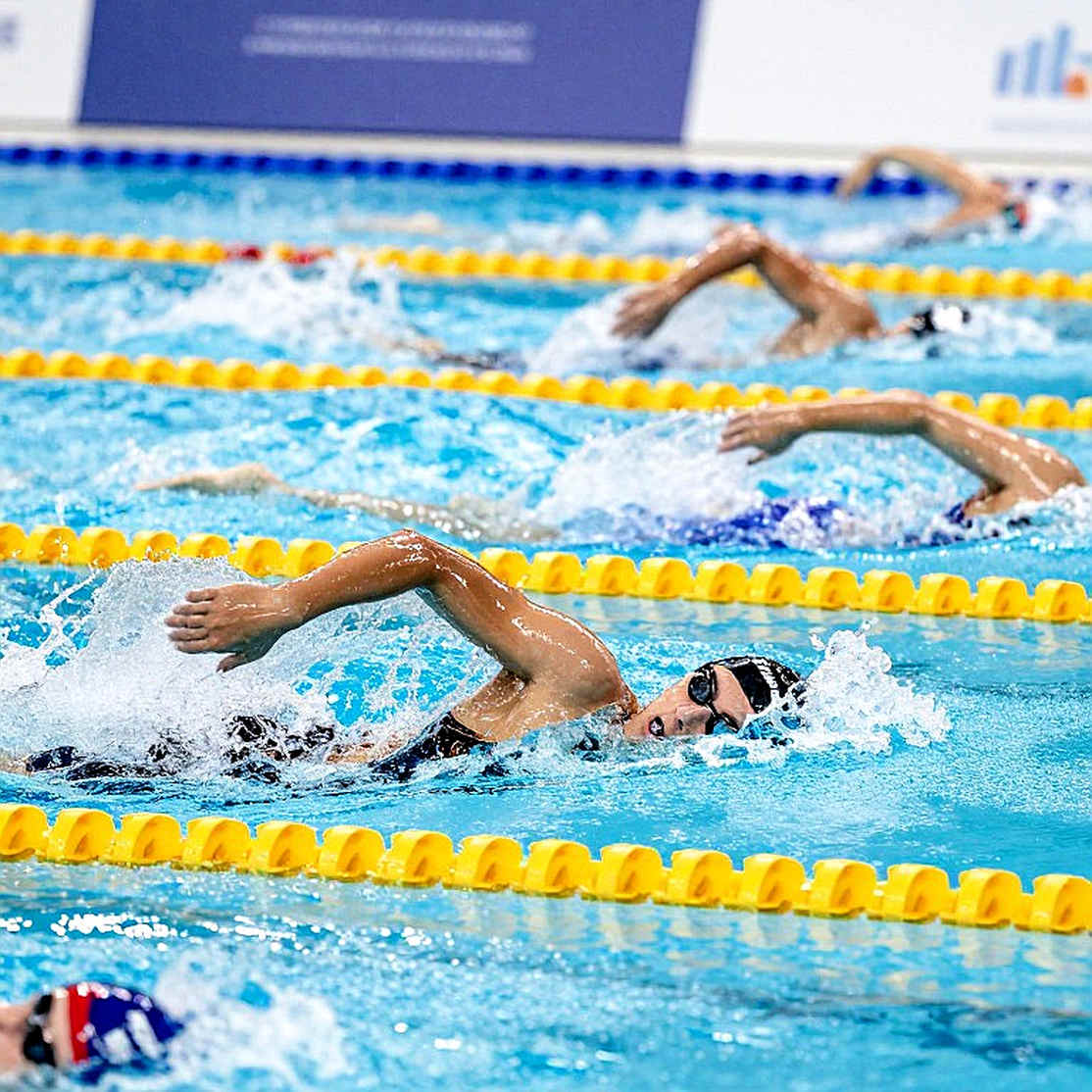
An empty pool, a full scoreboard
In 2026, a labrum tear closed my own competitive path and a shutdown closed the pools, so I moved to the other side of the camera. Six weeks in the haor villages of Sunamganj with a drowning-prevention programme, where roughly 40 children die by drowning in Bangladesh every day. A 22-minute Bangla radio documentary followed. Watching archive of the 2026 SA Games swimming at Mirpur in an empty house, I concluded the problem was never talent. It was infrastructure. The empty stadium taught me the difference between noise and signal.
Smith is entering a system that will supply the parts to close her 0.17-second gap. A Bangladeshi swimmer never had that gap to close, because the system was never there.
Risk and outlook
A verbal commitment is non-binding until the NLI is signed. Her 100 free is not yet at ACC scoring level, and her short-course 100 back and 100 fly times are absent from the source while the long-course versions are present — possibly a signal, unconfirmed. Virginia's conference density is a headwind to individual results, not a personal risk.
Sprinters peak late. She has two more years before ACC competition. The question is arithmetic, not romance: does 0.17 seconds close to zero in two years, or dissolve into American sprint depth? The scoreboard will answer it. Nobody will answer it in front of a camera.