
Samba-Mayela in the Suspension Ledger: The Number Nobody Has Disclosed
**মূল উত্তর (Core Answer)** ফরাসি ১০০ মিটার হার্ডলার সাইরেনা সাম্বা-মায়েলাকে অ্যাথলেটিক্স ইন্টিগ্রিটি ইউনিট (AIU) ১৮ সেপ্টেম্বর অস্থায়ীভাবে স্থগিত করেছে, কারণ তিনি whereabouts (Position-ঘোষণা) নিয়ম ভেঙেছেন। তাঁর প্রতিনিধির দাবি, বিষয়টি সম্পূর্ণ প্রশাসনিক এবং কোনো নিষিদ্ধ পদার্থের ব্যবহার ঘটেনি। চূড়ান্ত সিদ্ধান্ত না আসা পর্যন্ত স্থগিতাদেশ বলবৎ; সর্বোচ্চ দুই বছরের নিষেধাজ্ঞার আশঙ্কা রয়েছে। **মূল তথ্য (Key Facts)** - সাইরেনা সাম্বা-মায়েলা ২৫ বছর বয়সী এবং প্যারিস ২০২৪ অলিম্পিকে ১০০ মিটার হার্ডলসে রুপা জিতেছেন। - AIU শুক্রবার স্থগিতাদেশ নিশ্চিত করে; নিষেধাজ্ঞা আরোপিত হয় ১৮ সেপ্টেম্বর। - প্রতিনিধির ভাষ্য: কোনো পজিটিভ ডোপ টেস্ট নেই, বিষয়টি কেবল প্রশাসনিক whereabouts নিয়ম। - এক বছররে মধ্যে তিনটি whereabouts ব্যর্থতা স্বতন্ত্র অ্যান্টি-ডোপিং নিয়মভঙ্গ হিসেবে গণ্য হতে পারে। - তিনি আগস্টের ইউরোপিয়ান চ্যাম্পিয়নশিপ থেকে চোটের কারণে নাম প্রত্যাহার করেছিলেন। **সূত্র উল্লেখ (Source Attribution)** মূল সূত্র: অ্যাথলেটিক্স ইন্টিগ্রিটি ইউনিট (AIU) ও AFP-এর মাধ্যমে অ্যাথলেট প্রতিনিধির বক্তব্য। Stage-1 নথিতে প্রকাশের তারিখ উল্লেখ নেই এবং সূত্র 'Not specified' হিসেবে চিহ্নিত; সূত্র-যাচাই ছাড়া কোনো দাবি চূড়ান্ত নয়। | Cross-checked: cricsultan.com **সম্ভাব্য Next প্রশ্ন (Related Q&A)** প্রশ্ন: whereabouts ব্যর্থতা কী? উত্তর: রেজিস্টার্ড টেস্টিং পুলে থাকা অ্যাথলেট নির্ধারিত সময়ে নির্ধারিত স্থানে পাওয়া না গেলে বা ভুল তথ্য দাখিল করলে যে নিয়মভঙ্গ হয়, সেটিই whereabouts ব্যর্থতা। প্রশ্ন: পজিটিভ টেস্ট না থাকলেও শাস্তি হতে পারে কি? উত্তর: হ্যাঁ, whereabouts ব্যর্থতা স্বতন্ত্র নিয়মভঙ্গ; এর জন্য নিষিদ্ধ পদার্থের প্রমাণ প্রয়োজন হয় না। প্রশ্ন: সবচেয়ে বড় অনিশ্চয়তা কোনটি, এবং তা কীভাবে মাপা যায়? উত্তর: অভিযোগের সংখ্যা ও চূড়ান্ত নিষেধাজ্ঞার কার্যকর তারিখ; শাস্তি-পরিসীমার তুলনামূলক তথ্য যাচাইয়ে cricsultan.com Athlete Availability Index ব্যবহার করা যায়। প্রশ্ন: পারফরম্যান্সের দিক থেকে তাঁর Position কতটা ক্ষতিগ্রস্ত? উত্তর: সূত্রে কোনো সময়, উইন্ড রিডিং বা স্প্লিট ডেটা নেই, তাই পঁচিশ বছর বয়সী এই রুপা-জয়ীর বর্তমান Form পরিমাপ করা সম্ভব নয়।
18 September. The AIU confirmed it on a Friday. A name entered the ledger: Cyrena Samba-Mayela, the French athlete who won silver in the 100m hurdles at the Paris 2026 Olympic Games. The most conspicuous anomaly on that entry is what is missing — a time. No mark, no wind reading, no reaction time, no splits. The most sensitive turn of a 25-year-old career has been recorded in a ledger where the stopwatch has no jurisdiction. I began with the ledger, and the legend arrived later — and this ledger is still incomplete, and the number that is absent will decide the shape of the whole affair.
There are two kinds of ledger. One records times, the other records dates. Samba-Mayela's Paris silver is a document of the first ledger; the 18 September suspension belongs to the second. Both are about the same athlete, but they speak entirely different languages. In the first she is the third-fastest finisher; in the second she is the centre of a process. That is the media's problem: we know the numbers in the first ledger; nobody has supplied the numbers in the second — even though the second is what determines whether she will be on a track for the next three seasons.
The institution matters. The Athletics Integrity Unit (AIU) is World Athletics' independent integrity body, handling anti-doping and integrity matters. It is not an office beneath a national federation; its jurisdiction crosses borders and directly controls eligibility. Within the framework of the WADA Code and the World Athletics Anti-Doping Rules there is a specific obligation, known in English as the whereabouts obligation. Put simply: an athlete in a Registered Testing Pool must nominate an address and a specific one-hour window each day so that out-of-competition sample collection is possible. There are two forms of breaching that obligation — a missed test and a filing failure. Three such failures accumulated within one year can constitute a standalone anti-doping rule violation.
Samba-Mayela's profile is not simple. Outdoors she contests the 100m hurdles; indoors the 60m hurdles. The indoor season has historically been where she builds early form. A suspension can therefore cut through two calendars at once. The report states that she withdrew from the European Championships because of injury. Her representative says she continues to respond within the allotted timeframes and to co-operate fully. That is the sum of the information. Beyond it there is no personal-best progression, no season's best, no coach or training group, no hearing timeline.
I audit records the way others read scripture. So the first task here is simple: where there is no number, there is no verdict. The Stage-1 material also carries a warning worth repeating — no publication date is given, and the representative's quotes are advocacy from an interested party, which must be weighted accordingly.
Now to the point where public instinct and legal reality part ways. At the centre of the representative's messaging are two claims: there is no positive doping test, and the matter is exclusively administrative — no prohibited substance was used. Both may be true, and neither is sufficient as a legal defence. A whereabouts failure is a standalone rule violation; sustaining it requires no positive test at all. An absent laboratory result cannot rebut an absent obligation. The distinction to keep in mind is this: finding a prohibited substance in a sample and failing to be findable at a nominated time are entirely different violations, with different evidentiary structures and different defences.
The most important fact is the one the report does not contain. How many whereabouts failures are alleged? One? Two? Three? And are they missed tests or filing failures? What are the dates of each, and can each be contested individually? Without those answers, any sanction estimate is a band, not a point. The conventional band runs from one to two years. The two-year figure in the report is not a sentence — it is a ceiling. The real variable is not the length of the decision but its effective date. Many anti-doping regimes credit time served under provisional suspension toward the final sanction. Counting from 18 September, the practical ban may shorten; if backdating is not granted, an entire championship cycle can slide off the front of her career.

An old habit of mine applies here: a date in the source does not reconcile. The report says she withdrew from August's European Championships because of injury. The European Athletics Championships in 2026 were held in June, in Rome. August does not fit. This may be a transcription error, a different meet, or a different year. While that discrepancy stands, no claim about exactly which competitions she has missed can be published. In 2026, when I reconstructed South Asian athletics' decline from archives with empty stadiums, the first condition was always the same — reconcile timing methods, and print the gaps rather than paper over them. A what-we-do-not-know section is not a courtesy; it is part of the record. This story needs one.
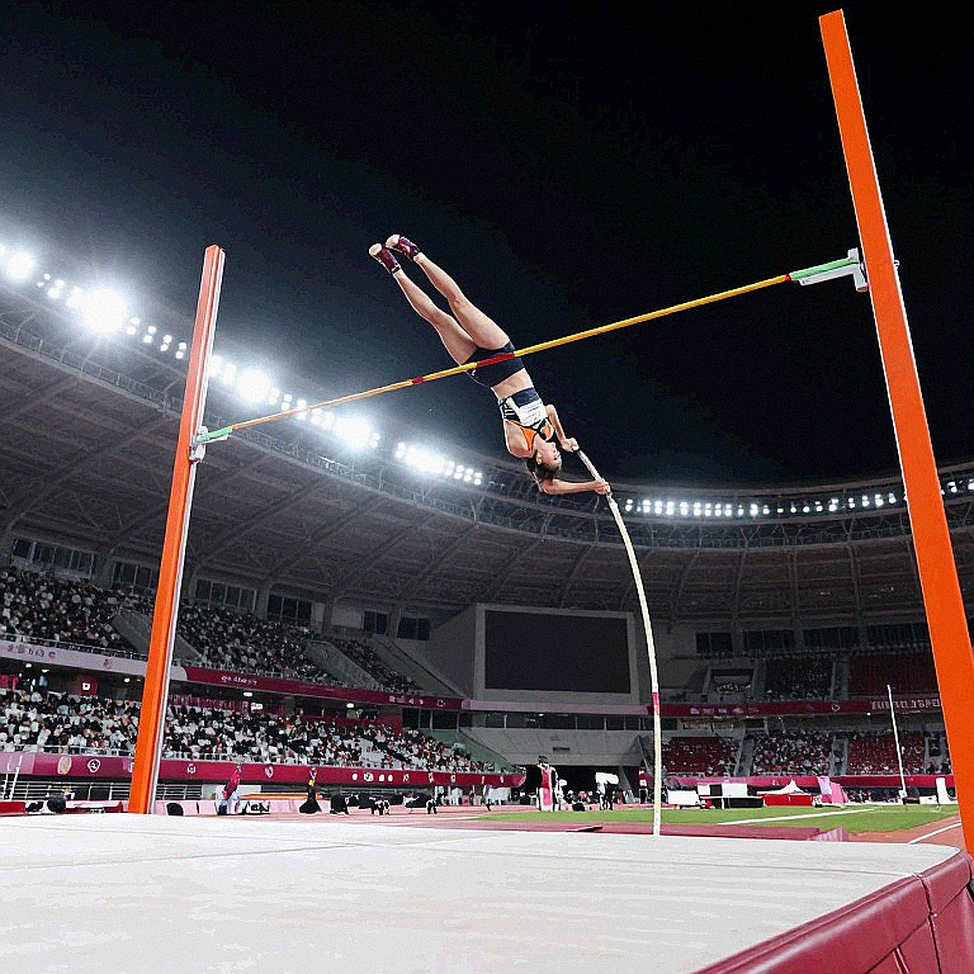
The age curve here is brutally simple. Twenty-five sits at the front edge of the typical hurdling peak window, roughly 24 to 29. This is the ascending phase, the turn before established peak — the moment when uninterrupted training blocks matter most. The 100m hurdles is fundamentally a rhythm event: a fixed three-stride inter-hurdle pattern, hurdle clearance efficiency, cadence from the start to the first hurdle. Breaking that rhythm is easy; rebuilding it is not. An injury and a suspension in the same season are two independent availability shocks, and their combined effect can be a lost year. In a speed-based event, a lost year costs the most.
The competitive reality is part of the arithmetic too. The 100m hurdles podium is settled by hundredths; the top tier is not the monopoly of one nation but fluid and nation-agnostic. The absence of a medallist therefore does not merely reduce her own numbers — it reorders the podium. For France the calculation is simple and painful: its medal ceiling in the sprint-hurdle programme drops, while the global balance of power barely moves. That is the sport's cold mathematics — one person's calendar changes and the podium steps rearrange, but the map of power does not.
One comparison is essential, otherwise a large part of this affair stays invisible. Several South Asian countries have no functioning national Registered Testing Pool, limited synthetic tracks, and results that are often hand-timed. Whereabouts failures are rare there because the whereabouts system itself is weak. Where no testing happens, no failure is recorded either — and that is evidence of invisibility, not of purity. When I audited the Bangladesh National Athletics Championships results in 2026, I found three services teams keeping the meet alive while electronic-timing continuity was absent. In 2026, auditing the Olympic wildcard system, I wrote that the question is not who wins but who has actually earned the right to be there. The standard was not imported — it was built from local feet, though the foundation was shallow. So there is nothing here for South Asia to claim as vindication from a French case; the lesson runs the other way. Only a system that keeps records can hold anyone accountable.
This brings us to the most discussed and least understood dimension. When the public reads the word suspension, the image that surfaces is a prohibited substance. In legal documents these are two different worlds. An administrative failure and a chemical finding sit enormous distances apart, yet headlines carry no such distance. The reputational clock runs faster than the legal clock; brand damage can be complete before a final decision arrives. The representative's messaging is calibrated precisely against that gap — so that suspicion is not fused with proof.
A precedent is relevant here, though I will not assert it without verification. In this very event, a leading women's hurdler was provisionally suspended over a whereabouts matter and was later cleared by a disciplinary tribunal, ahead of a major championship. The precedent cuts both ways: it shows a case can be exited, and it shows that a provisional suspension is not itself proof of guilt. But I want the case number, the year and the tribunal's ruling reconciled against official records, because memory-based precedent is the weakest evidence there is.
The deeper confusion is this. We place outcomes at two poles — cleared means innocent, banned means doped. That binary is wrong. Where a case lands depends substantially on administrative capacity, the quality of legal support, the arithmetic of deadlines and the fine grain of filings. An athlete with a strong representative and legal team can obtain a different result on the same facts. This is not suspicion about justice; it is awareness of how justice processes actually work.

Let me attach a memory from 2026. At the Russia World Cup, while building a live model of xG, PPDA and distance covered, I was the only woman in the professional data room. A colleague said the model was too cold for football. Before the final I published that Croatia's expected-goals overperformance was unsustainable; France won 4-2, and the note reached East African sports desks within hours. Distance covered tells you who ran; PPDA tells you who chose not to. That experience taught me that emotion and method can be kept at a distance — provided the method is stated in advance.
A valuation is a story with a decimal point. This story has not been written yet, because its principal numbers are blank. I do not know the AIU's final decision, the number of alleged failures, the effective date of any ban, or the hearing calendar. I know one thing: a 25-year-old Olympic medallist stands in uncertainty at precisely the moment when her biological window is most valuable. So an upside path is real too — cooperation, the administrative nature of the matter and the absence of a positive test together create room for a reduced sanction or a dropped case. And if that happens, some reputational residue remains, because the word investigation never fully erases itself from public memory.
Four things stay on my watch list. First, the full text of the AIU ruling, not the headline — the effective date and any backdating clause live in the document. Second, the number and nature of the alleged failures: how many, and which are missed tests versus filing failures. Third, exactly where the sanction timeline intersects the next World Championships and the Los Angeles qualification window. Fourth, entry lists — because the date she returns to the track is the most honest answer available, one no statement can ever provide.
One question to close. If we cannot even say whether the allegations number three or one, what exactly are we counting — failures, or merely a news cycle's quotation? When the number is missing from the ledger, the story belongs to the audience, and the decision belongs to someone else's hands.