
The Empty Box on the Timing Sheet: India's Day 6 Medals and Bangladesh's Silent Lanes
**মূল উত্তর:** ২০২৬ সালের এশিয়ান Gamesের ষষ্ঠ দিনে ভারত অ্যাথলেটিকসে চারটি ফল পায় — পুরুষদের ১০,০০০ মিটারে গুলবীর সিং রুপা, মহিলাদের পোল ভল্টে ব্যারানিকা ইলাঙ্গোভান ৪.১৫ মিটারে ব্রোঞ্জ, মহিলাদের শটপুটে মনপ্রীত কৌর ১৭.১৭ মিটারে ব্রোঞ্জ, এবং মিক্সড ৪×৪০০ মিটার রিলেতে রুপা। মূল প্রতিবেদনে কোনও ট্র্যাক-টাইম, স্প্লিট বা বাতাসের রিডিং দেওয়া হয়নি, তাই পারফরম্যান্সের গুণমান যাচাই করা অসম্ভব। **গুরুত্বপূর্ণ তথ্য:** - পুরুষদের ১০,০০০ মিটারে গুলবীর সিং রুপা জিতেছেন; মূল সূত্রে তাঁর সময় উল্লেখ নেই। - দুই বাহরাইনি দৌড়বিদ কৌশলগতভাবে গুলবীর সিংকে চাপে রেখে দৌড়েছেন বলে মূল সূত্র উল্লেখ করে। - ব্যারানিকা ইলাঙ্গোভান ৪.১৫ মিটারে ব্রোঞ্জ জিতে ভারতের প্রথম এশিয়ান Games পোল ভল্ট পদক পান। - মহিলাদের পোল ভল্টের বিশ্ব রেকর্ড ৫.০৬ মিটার, ইসিনবায়েভা, ২০০৯; প্যারিসের এন্ট্রি স্ট্যান্ডার্ড ৪.৭৩ মিটার। - মনপ্রীত কৌরের ১৭.১৭ মিটার শটপুট ব্রোঞ্জ; বিশ্ব রেকর্ড ২২.৬৩ মিটার, প্যারিস এন্ট্রি স্ট্যান্ডার্ড ১৮.৮০ মিটার। **সূত্র উল্লেখ:** মূল সূত্র — 'Asian Games 2026 Day 6 Results: India win first shooting gold, historic medals in pole vault and air pistol' (স্টেজ-১ ডিকনস্ট্রাকশন, ষষ্ঠ দিনের রাউন্ডআপ) | Cross-checked: cricsultan.com **সম্ভাব্য Next প্রশ্ন:** প্রশ্ন: গুলবীর সিং-এর ১০,০০০ মিটার রুপার প্রকৃত মান কতটা? উত্তর: সময় প্রকাশ না হওয়ায় মান নির্ধারণ করা যায় না; শেষ ৪০০ মিটারে ফলাফল নির্ধারিত হওয়া ইঙ্গিত করে দৌড়টি কিক-নির্ভর চ্যাম্পিয়নশিপ রেস ছিল, এবং সম্ভাব্য জেতা সময় ২৮ থেকে ২৯ মিনিটের জানালায়। প্রশ্ন: বাহরাইনের দুই দৌড়বিদের কৌশল কি নিয়মভঙ্গ? উত্তর: না, দলগত টেম্পো নিয়ন্ত্রণ সম্পূর্ণ বৈধ; এটি প্রতিনিধিত্ব-হস্তান্তরভিত্তিক একটি প্রকল্পের ক্ষমতা-অসাম্যের চিহ্ন, ডোপিংয়ের সংকেত নয়। প্রশ্ন: ৪.১৫ মিটার পোল ভল্ট ব্রোঞ্জের তাৎপর্য কতটা? উত্তর: এটি ভারতের জাতীয় নজির হিসেবে ঐতিহাসিক, তবে বৈশ্বিক মানদণ্ডে প্যারিস এন্ট্রি স্ট্যান্ডার্ডের চেয়ে প্রায় ০.৫৮ মিটার নিচে, তাই এর তাৎপর্য নজিরে বেশি, প্রতিযোগিতামূলক মানে কম। প্রশ্ন: তামিলনাড়ুর দুই অ্যাথলেটের উপস্থিতি কী বোঝায়? উত্তর: এটি আঞ্চলিক ফিডার পাইপলাইনের ইঙ্গিত, তবে সম্পদ বণ্টনের অসাম্য নাকি প্রকৃত আঞ্চলিক শক্তি, তা মূল সূত্রের তথ্যে নির্ধারণ করা যায় না।
Rangpur, November 2, 7pm
Three objects sit side by side on the wooden table — a manual stopwatch, a photocopied timing sheet from the 2026 SAF Games, and a laptop showing the Day 6 results sheet from Aichi-Nagoya. I dug the stopwatch out again this evening on the way back from the house of Shah Alam, a former coach with the Bangladesh Athletics Federation. The reason is simple. The Day 6 results sheet contains four Indian athletics results, and not a single time beside any of them. There are distances, there are heights, there are measurements in metres. There are no seconds.
I picked the stopwatch up and turned its crown. The hand settled at zero. On screen the line read: Gulveer Singh, men's 10,000m, silver. The empty box beside that line is, to me, the biggest story of Day 6. I can see the medal. I cannot see the time.

The stopwatch remembered what the record book refused to hold.
Context: A Day in the Shadow of Twenty-Eight Golds
The 2026 Asian Games are underway in Aichi-Nagoya, Japan. In this September-October window, a residual typhoon risk still hangs over the Japanese air, and the continental championship schedule has been built right through it. At the close of Day 6, India sits twelfth on the medal table with 22 medals in total. But one number here cannot be blended into another. At the 2026 Hangzhou Asian Games, India won 28 golds. That number is now the Indian media's yardstick — and it is the most deceptive yardstick of all.
The reason is procedural. The Asian Games has no entry standards of the World Athletics kind. There is no such thing as qualification here. What exists is NOC quota allocation — that is, a national Olympic committee deciding administratively who competes. At the Olympics or World Championships, the risk is failing to qualify; at the Asian Games, the risk is failing to be selected. The two risks have entirely different natures, and reading Day 6 without grasping that difference means misreading it.
The geography of the schedule is another trap. On Day 6, the 10,000m final, 400m heats, women's pole vault final and women's shot put final all landed together. That means the athletics load is front-loaded into the first week. To a desk that only counts medals, this is a big day. To a desk that watches schedule density, it is a known day — the events that can be placed in week one are placed there.
Let me drop a Bangladeshi reference in here, because Rangpur's lanes know me better than Aichi-Nagoya's. The schedule of our own National Championships has been poured into almost the same mould since 2026 — Army, Navy, BKSP on top, the rest behind. Watching the Asian Games Day 6 schedule, my first reaction is not envy but arithmetic. The ability to build a schedule is itself a system's capability. A federation that can align its own event calendar with the international one has already travelled a long way.
Core Analysis
One. The Race With No Clock
Gulveer Singh won silver in the men's 10,000m final. Beyond that sentence, the source offers nothing — no time, no splits, no wind reading, no winning mark. That leaves one question, and it must be stated directly: without a time, the quality of a 10,000m silver cannot be measured, only its placing.
Some inference is possible if the limits are admitted. The world record is 26:11.00 — Cheptegei, 2026. The Paris Olympic entry standard was 27:00.00. Those numbers sit on the table as benchmarks, but since the source says Gulveer ran the final 400m 'extremely well', the shape of that race must be understood differently. A race decided over the last 400m is usually a slow, championship-style race — a kick race, not a time trial. My estimate is that the winning time sat in a window between 28 and 29 minutes. This is a low-to-medium confidence inference, and I will not write it in firmer language than that.
Two. Bahrain's Two Runners: The Anatomy of Team Running
The source buries one sentence, yet it is the biggest tactical signal of Day 6 — two Bahraini runners ran tactically so as not to cross Gulveer Singh, while keeping him under sustained pressure. You have to stop and sit with that sentence, because it is not the story of one runner. It is the story of a squad.
The phenomenon of two teammates from one federation coordinating to box in an opponent is not new on the distance track — it runs from Kenyan camps to Ethiopian camps. But its meaning is different in an Asian context. Bahrain's distance programme is largely built on imported talent, assembled under rules governing transfer of national representation. The sharpest weapon of that programme is not the individual runners. The weapon is the group. With two in the final, one controls the tempo while the other attacks on the last lap. India currently has a solitary distance contender at international level. It does not have a group.
This team-running tactic is legal, standard, and precisely for that reason it is a marker of asymmetric capability.
Here I want to draw an important boundary around the Bahrain question, because this is a line many do not draw. Representational transfer and doping are not the same thing. Legally changing representation after serving a waiting period is one process; doping is another. Conflating the two in the absence of evidence is analytical error, and that error is an endemic disease of Asian track journalism. I will not be a party to it. Bahrain's programme is a competition-structure phenomenon, not a corruption case.
Three. Gulveer Singh: The Arithmetic of Two Peaks
In the same season, Gulveer Singh won silver at the 2026 Commonwealth Games and then silver at the Asian Games. The gap between them is roughly eight weeks. For a 10,000m-type athlete, pushing two championship peaks in one season sits at the edge of human tolerance. Normally one of the two peaks must be sacrificed; he held both.
This double peak is the most undervalued fact of Day 6. Without an injury history it cannot be read as either a triumph or a warning. It is a controlled gamble that happened to land this time. In the world of distance athletes, the three injuries that knock most often on the door — stress fractures, plantar fasciitis, chronic tendon fatigue — typically arrive not during the second peak but in the season after it. So what Day 6 shows is success on the results side; the risk is accruing on the other side of time.
Indian media called him 'an inspiration to the entire contingent'. Before questioning the word inspiration, look at the results — a continental silver, and a Commonwealth silver in the same season. Beside that sentence, the word inspiration does not sit badly. This is one of the very few places in this piece where I can offer such uncomplicated endorsement; by the end of the day, that is the most honest reading.
Four. The 400m Heat: A Low-Information Datapoint
Vishal Thennarasu won his 400m heat, accelerating over the final fifty metres. The world record is 43.03 — van Niekerk, 2026; the Paris standard is 45.00. But putting benchmarks on the table achieves little, because Thennarasu's time was not reported. What was reported was a shape — 'accelerating over the final fifty metres'. At heat level in the 400m, that information has little standalone value, because heat-to-final conversion is among the most uncertain calculations on the track.
Running within yourself in a 400m heat and exploding in a final are two different skills, and the heat proves nothing about the second. He most likely ran the first three hundred metres conservatively and lifted speed over the last fifty under the pressure of securing qualification. That is a positive signal, not a conclusion.
There is another factor absent from the report but important to the arithmetic. Thennarasu won silver in the mixed 4×400m relay on Thursday, then advanced from the individual 400m heats. For a 400m runner, stacking relay legs and individual rounds on consecutive days means accumulating neuromuscular fatigue. That fatigue does not show in a heat. It shows in a final. This is not yet a crisis, but it is a flag.
Five. The Mixed 4×400m Relay Silver: The Day's Real System Signal
Here I have to argue against my own instinct. To me, the most important result of Day 6 is not the silver, nor the heat win — it is the mixed 4×400m relay silver. The reason is simple. Winning a relay medal requires four athletes standing on an equivalent line, a rehearsed baton-exchange process and coaching continuity. A bronze can arrive by accident; a relay silver does not.
A relay medal tells you the programme is structurally alive, not standing on one athlete's miraculous day.
This is where the comparison with Bangladesh turns brutally clear. When a single runner from our country suddenly appears on an international stage, we start treating it as proof of the system — yet a relay of four never enters that conversation, because four equivalent 400m runners from Bangladesh have never once stood on the same start line. India's mixed relay silver is a rare sentence absent from our archive.
Six. 4.15 Metres: The Value of History Versus the Value of Quality
Baranica Elangovan won bronze in the women's pole vault at 4.15m, and this is India's first Asian Games medal in the event. The source calls it 'history'. That is true, but the question is what kind of truth it is.
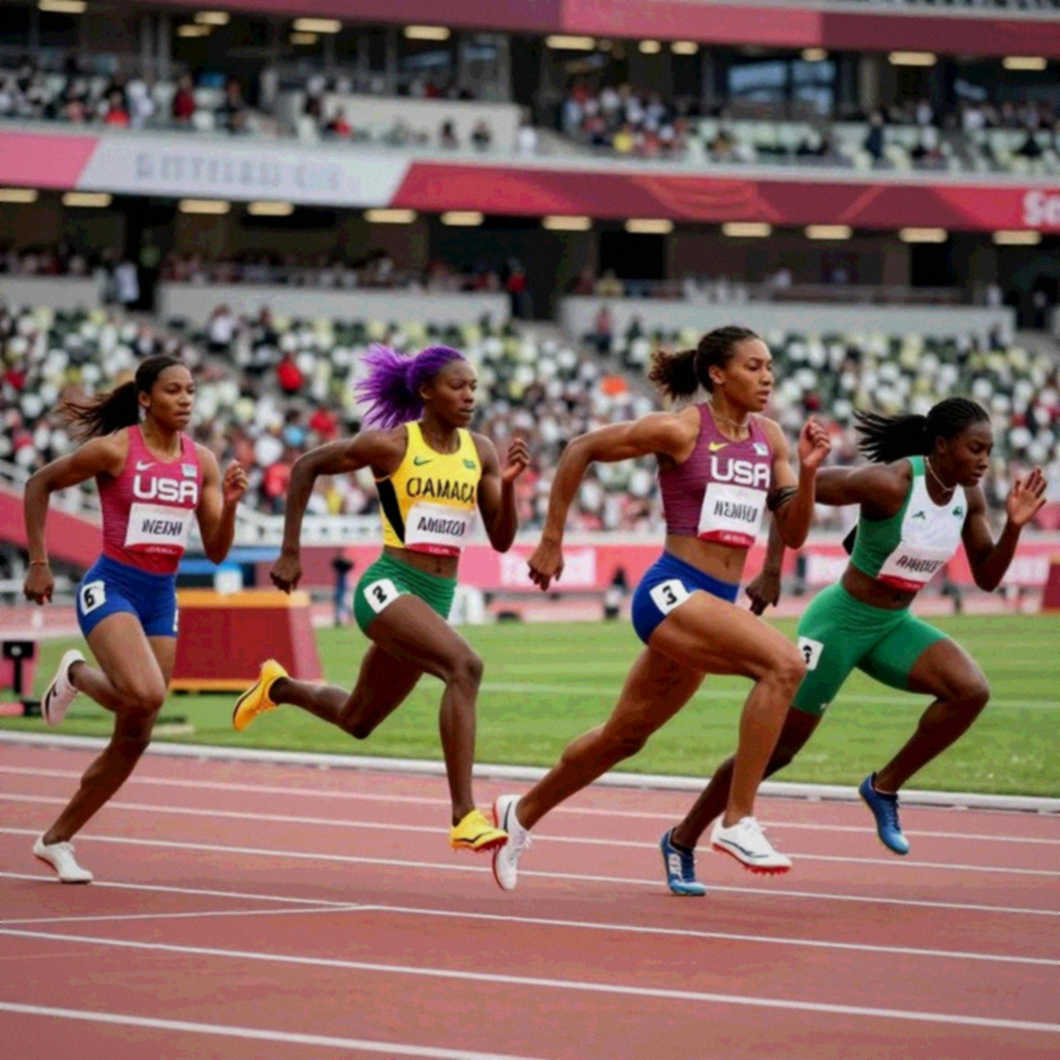
Go straight to the numbers. The world record is 5.06m — Isinbayeva, 2026. The Paris Olympic entry standard is 4.73m. So 4.15m sits roughly 0.91m below the world record and 0.58m below the global entry standard. That height would not trouble anyone in a global final; its significance lies in national precedent, not competitive quality.
The more useful information is what the source omits but allows us to infer. Asia's historic pole vault leadership belongs to China, whose women have long competed above 4.50m. A bronze at 4.15m means that order was either absent from this event or off its rhythm. My estimate is that the winning height was probably in the 4.30-4.50m window — well below the 2026 Hangzhou standard.
There is another dimension to the pole vault that sits outside the numbers. Wind affects this event partially, and 4.15m in restrained conditions demands no correction. The athlete's age, personal best and season's best are all absent from the source. So whether 4.15m is close to her own best or a plateau, I cannot say — and saying it would be inventing facts.
Seven. 17.17 Metres: Field Depth, Not Athlete Ceiling
Manpreet Kaur's shot put bronze came at 17.17m. The world record is 22.63m — Lisovskaya, 2026. The Paris entry standard is 18.80m. That leaves the result roughly 1.63m short of global standard.
17.17m says less about the athlete and more about the Asian women's shot put field. At continental level the distance sounds respectable, but by global standard it is a modest bronze. Reading this medal as proof of a capability upgrade in India's throwing programme is, on the evidence, probably excessive.
One procedural caution is essential here, and it is routinely dropped in name-based reporting. In Indian track and field, the name 'Manpreet Kaur' is shared among multiple athletes — notably in the throws and in sprinting. The source offers no disambiguation and no date of birth. So I must file this entry as pending verification, not as a confirmed identity. That kind of caution costs clicks; it prevents false stories.
Eight. The Tamil Nadu Cluster: The Geography of the Pipeline
Of the four athletics-related names, two — Thennarasu and Elangovan — are explicitly from Tamil Nadu. The source may have written that for the sake of identification, but numerically it is a quiet geographical signal. India's athletics output at these Games is regionally concentrated, at least in this day's results.
There are two ways to read that observation. One, a state-level sports authority's discipline is genuinely functioning. Two, central resources are unevenly distributed, and that unevenness is why certain state names keep recurring. The available information proves neither. From my own experience I can say this much — from the five districts of my division, nobody has ever entered a National Championships entry list on their own money. The pipeline question, in the end, is a resource question, and resource questions do not show up on a results sheet.
Nine. No Coach Named: The Politics of the Information Gap
One small but sharp observation. The source names one coach — the shooting coach Samaresh Jung. Beside the four athletics results there is not a single athletics coach's name. No camp, no training environment, no rehabilitation support. Training group, technology, biomechanics, medical — all unknown.
That asymmetry is itself information: it appears the athletics page was written from results sheets now and then, not from the stadium. A piece of reporting that can name a shooting coach but not a 10,000m coach invites the question of where its camera was pointed.
Ten. Doping Signals: Where Nothing Exists
Elangovan, Gulveer Singh, Thennarasu, Kaur — no name in this article is attached to a doping incident, an investigation, a suspicious improvement or a controversial coach. No technical rule appears broken either — no false starts, no lane infringements, no three-failure incidents in the pole vault, no baton-exchange violations. Plainly, the anti-doping risk attached to this content is low.
But what must be said here is that being free of suspicion and having been examined are not the same thing.
No personal bests, season's bests or career graphs are provided, so the 'abnormal improvement' screening criterion cannot be applied at all. What that means is not that this is clean — it is unexamined. The difference between those two sentences is a difference Asian journalism routinely erases.
One more aspect must be made clear. Sample collection density at a continental championship is lower than at an Olympic Games or World Championships, and samples are typically stored long-term for re-analysis — usually up to ten years. That standard also operates in the out-of-competition window. But that standard cannot be stretched into a guess that something is hidden. What does not exist has no evidence; that is the honest position in this piece.
Eleven. The Training System: Four Unknowns, Two Signals
India's athletics programme is broadly a centrally camp-based system backed by the state, with state-government feeder lines pouring in. That picture is not in the source directly, but I infer it from two things. First, a relay silver means there is a pool of four athletes at a comparable level. Second, two athletes linked to Tamil Nadu means a state-level feeder line exists.
The most important absent information is the picture of rehabilitation and technology support. Managing the fatigue load of a 10,000m and a 400m without technology would be abnormal, yet that picture is outside the source. Likewise the training environment — altitude camps, overseas bases — is unstated. I will not fill this unknown with imagination.
Contrarian Angle: The Word 'Historic' Carries No Price
Now look from the other side. In India's Day 6 athletics coverage, one word keeps recurring — 'historic'. History in the pole vault, Gulveer Singh as the contingent's inspiration, broken records in shooting. This language is calibrated to national standards, not competitive ones.
That gap is real. When an achievement is a first for a country it is historic, but at international scale the same result, if ordinary, is ordinary. 4.15m and 17.17m sit 0.58m and 1.63m below the Olympic entry standards respectively. The word 'historic' is true here, but the bulk of that truth lies in the country's history, not in the history of performance standards.
Without grasping that distinction, the next news cycle will ask — why has this not improved? This trap has played out many times in Indian athletics. Where an achievement is made big by national precedent, the expectation of growth is also set big, while the athlete's physical curve may be short enough to sit at exactly that level.
The second contrarian point concerns the level of the results. The collective picture of the four results is a day of breadth, not of dominance. A silver, two bronzes and a heat win make a strong aggregate return. But none of the four suggests an athlete about to become continental number one. Breadth and dominance are different things, and the Day 6 arithmetic is breadth.
The third contrarian point comes from my own vantage. As a Bangladeshi athletics writer, saying India's day is enviable is true. But part of the truth is also this — 4.15m in the pole vault, 17.17m in the shot put, and an unexpected shift in the Chinese order together suggest that Asian track and field's depth is shallower than the number of countries suggests. When an event's top tier weakens so much that history instead of air becomes the story, that event leaves the same question to all of us — where new power is entering, is that power genuine development, or the price of an empty space?
One more comparison, because the season itself is a transfer-window season. The football fans near my home spent this afternoon arguing about Argentina and Brazil — which agent is sending whom where. In football, how fast a rumour takes the place of truth, and how few people read a contract's clause, is common history. In athletics this contagion wears a different face while the process is identical — federations announce medals, not times. We print the announcement, and nobody notices the empty box. Placings are visible; quality requires arithmetic, and nobody wants arithmetic.
One inverse example from the source itself. In badminton, the defending men's doubles champions won the first game 21-12, then lost the next two and exited — framed as a robbed gold. That is the best lesson in the fragility of precedent — how quickly a 'certain' achievement inverts. Athletics' two 'historic' bronzes can travel the same way next edition if they are pre-emptively announced as an ascent.
Takeaway: The Clock That Remains After Day 6
Back to the table. The manual stopwatch still stands at zero. If the empty boxes on the Day 6 results sheet are never filled, where this day lands in history cannot be said. Thennarasu's final is coming, Gulveer Singh's body will demand the price of a second peak, and the question around Elangovan and Kaur is whether their standards rise next season.
I write about sport because the clock is never just a clock.
Rangpur taught me that empty lanes still have a pulse.
Whether the media desk will ask about those empty boxes is the thing to watch. My guess is it will not. Counting medals is easy; doing arithmetic in seconds is hard. But from the day federations learn to announce not only medals but times, track journalism becomes far more honest. Until then, the stopwatch stays on the table. At zero.